
Leading the LED Revolution for Petrol Stations
How the forecourt price board went from a man on a ladder with plastic flip-digits to instant, remote, sunlight-bright LED — and the part AVS has played for over 9 years.
Drive past any petrol station today and the fuel price reads back at you in crisp, glowing digits — visible from across a four-lane road, identical on every face of the pole, and matching the pump cent-for-cent. It is easy to forget that this is a relatively recent state of affairs. For decades the forecourt price board was one of the most stubbornly manual objects in modern retail, and replacing it has quietly reshaped how fuel brands present themselves on the street.
The old way: plastic digits and a man on a ladder
Before LED, the price on the pole was a set of physical flip-digits — printed acrylic or coroplast cards slotted into a frame, or hinged numbers turned over by hand. When head office moved the price, someone had to physically attend each site, climb to the board, and swap the digits one panel at a time. On a tall monolith that meant a ladder or a pole tool, often in traffic, sometimes in rain.
The problems compounded. A site might change price two or three times a day during a volatile week, and every change was a trip up the ladder. Digits were swapped in the wrong order, or the pole was updated hours after the pump — so the number on the street no longer matched the number at the dispenser, an embarrassment with real compliance weight behind it. Under tropical sun the printed faces faded to a washed-out pink within a season, and at dusk an unlit board simply vanished. The price board, the single most important number a station broadcasts, was also its least reliable.
The shift: LED Price Change Units
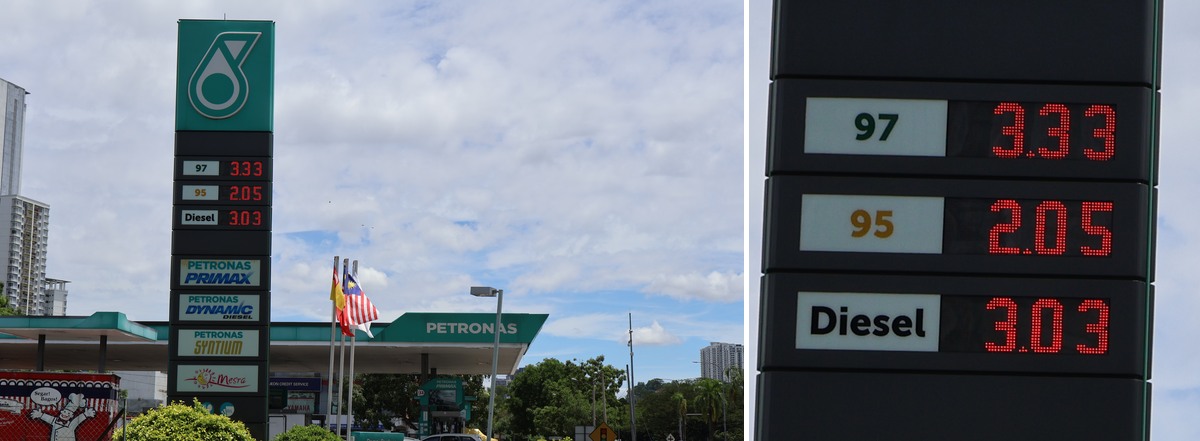
The LED Price Change Unit (PCU) collapsed all of that into a controlled, electronic display. Instead of a frame of cards, the pole carries segmented LED digits driven by a controller. A change that once meant dispatching a person now takes seconds: the operator presses a five-button remote at the kerb, keys the figure into a 16-key Price Sign Terminal, or — where the station runs an integrated forecourt — lets the price flow automatically from the POS so pole and pump update together.
Brightness is no longer a compromise. AVS PCUs run a 64-level automatic photocell, throttling the display down at night so it does not glare and pushing it to full output under direct sun, where the digits stay legible across 120° of viewing angle. The colour is consistent for the life of the unit — red, green, white or dual-colour — with no fading. Some operators exploit the dual-colour capability directly: at Vivo in Indonesia the boards run red by day and switch automatically to white at night, a single sign earning its keep around the clock.
What actually changed for operators
Strip away the technology and the gains are operational. The differences a station manager feels day to day are concrete:
- Price accuracy. The pole price can be slaved to the pump via POS / IFSF integration, so the two can no longer drift apart.
- Sunlight visibility. High-output LEDs on automatic brightness stay readable at noon and controlled after dark — no fade, no dead board at dusk.
- Brand image. Uniform digits across every site put a consistent, modern face on the network instead of patchy hand-set cards.
- Less maintenance. No printed digits to reorder, no climbing for routine changes, and a sealed IP54-to-IP67 build rated from −30 °C to +60 °C for the long haul.
- Speed at scale. One PCU Controller drives up to eight PCUs, so a multi-pole site updates from a single point.
AVS's role for over 9 years
AVS Display has served petrol-station forecourts for over 9 years as a Malaysian manufacturer built specifically for the forecourt — not a general signage shop that happens to sell price boards. From its own plant the company runs automated SMT, wave-soldering and Plug-&-Place lines, and builds only on premium LED — Cree and Osram — rather than commodity diodes. Over that time AVS hardware has gone up for Petronas, Shell, BHP, Aramco, Vivo, Uni-Oil and Petron across the region — including units on Petronas and BHP forecourts that have been on-site for 9+ years, with one Petronas unit still lit after roughly 8 years in service. The Price Change Unit sits at the centre of a forecourt system that also covers LED tubes, modules and outdoor signage, and our petrol-station solution ties the pieces together for the people who run fuel sites.
The forecourt is where AVS started and where the engineering is sharpest.
Built to be certified and tested
A price board is an outdoor electronic product that sits in public view for years, so the build is treated accordingly. Every unit is engineered to the standards a fuel brand expects, and the qualification programme is run before product leaves the line:
| IFSF | Forecourt price-pole certification for POS / controller integration; certificate reference available on request. |
|---|---|
| CE / EMC | Tested for emissions and immunity to the applicable European standards; test reports available on request. |
| FCC | Compliance testing for the electronics and the wireless remote; documentation available on request. |
| RoHS | Restricted-substance conformance; documentation available on request. |
| Reliability testing | Burn-in, cold-chamber dry-joint test, vibration test and conformal-coated PCBs before shipment. |
That combination — instant remote control, sunlight-grade brightness, consistent colour and a certified, hard-tested build — is what turned the forecourt price board from a liability into an asset. The man on the ladder has earned his retirement. Full detail on the standards behind every unit is on our certifications page.
Ready to retire the ladder?
Tell us about your network and we'll spec the right Price Change Unit and integration for your forecourts.