
Dual-Colour LED Price Signs: Red by Day, White by Night
Why a forecourt price sign that changes colour with the sky reads better at noon and after dark — and how AVS makes it automatic.
On a petrol-station forecourt, the price sign has one job: to be read clearly from the road, at a glance, by a moving driver. That sounds simple until you watch the same monolith across a full day. At noon under tropical sun, a display that looked crisp at dusk can wash out into a pale grey smear. After sunset, a sign tuned for daylight can glare so hard it bleeds and loses its sharp digit edges. The lighting conditions on a forecourt swing further than almost any other outdoor signage faces — and a single fixed colour rarely wins in both.
The readability problem: glare by day, contrast by night
Two different physics problems are at play. In bright daylight the enemy is glare and wash-out — ambient light floods the sign face and flattens the contrast between the lit digits and the dark background panel. Cooler colours like white and blue suffer most here, because the surrounding daylight is itself broadband white; the digits stop standing apart. After dark the problem inverts. The background is now genuinely black, so contrast is easy, and the eye becomes far more sensitive. A daytime-bright sign can dazzle, and warmer colours can look muddy against deep night.
The practical result is familiar to any forecourt operator: a sign that is perfectly legible in the morning draws complaints about being hard to read at midday, or looks fine at night but disappears in the afternoon. Drivers slow down, miss the price, or pull in expecting one figure and see another. On a competitive corner where the station across the road is also flashing its numbers, a few unreadable hours a day is lost business.
How dual-colour works: red for sun, white for night
AVS dual-colour Price Change Units carry two LED emitters behind every digit segment — a deep red and a clean white. Red around 625 nm is the standout performer in direct sun. The human eye holds onto saturated red against a bright sky, and red digits keep their hard edges and high apparent contrast even when ambient light is hammering the sign face. That is exactly why classic fuel-price boards have always been red. So through the daylight hours the display runs its red emitters and stays punchy in the harshest glare.
White wins after dark. Against a black night background, white digits deliver the brightest, cleanest read and the strongest pull from a distance, without the muddiness a warm colour can show at night. As the sky darkens, the sign transitions to its white emitters and keeps that crisp, high-visibility look until dawn — then switches back to red for the next day.
Automatic switching — no staff, no schedule
The switch is not on a timer and it is not a job for the cashier. Every AVS PCU carries a built-in photocell, the same ambient-light sensor that drives the unit's auto-brightness. As real-world light levels fall through dusk, the sensor reads the change and the display moves from red-by-day to white-by-night on its own. No one walks out to the monolith; nothing is scheduled in a back office; the sign simply follows the actual sky, so it stays right on cloudy afternoons and long evenings alike, not just at a fixed clock time.
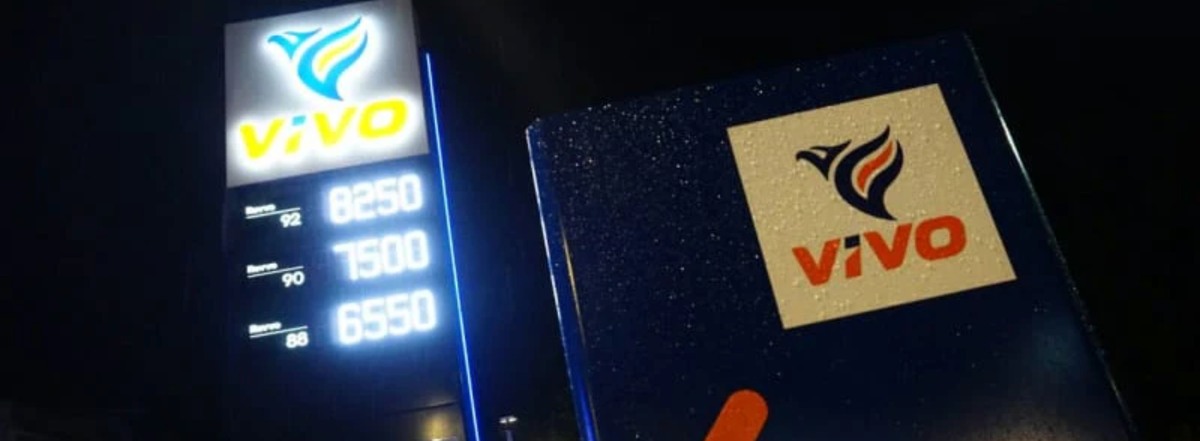
This is exactly what AVS deployed at Vivo stations in Indonesia. Their forecourt price displays run red through the day, switch to white as the sky darkens into night, and reverse the next morning — all automatically, off the on-board ambient sensor, with no staff action on site. It is dual-colour working the way it is meant to: invisible to the operator, obvious to the driver.
What operators get out of it
- Maximum legibility in every condition — red holds up against midday glare, white cuts through the dark.
- Brand consistency: the price reads the same way to every driver, every hour, with no dead patches in the day.
- Fewer "I couldn't read the price" complaints and fewer drivers slowing or turning away.
- Zero staff workload — no manual switching, no timers to maintain, no one sent out to the pole.
- Correct behaviour year-round, because the sign tracks real ambient light rather than a fixed schedule.
Built on the same auto-brightness and weatherproof platform
Dual-colour switching rides on the engineering already inside every AVS Price Change Unit. The same photocell that selects the colour also drives 64-level automatic brightness, so the sign is never blinding at 2am or invisible at noon — it is continuously dimmed and brightened to suit the light. Both functions run off one ambient sensor, with no extra hardware to wire and nothing for staff to set.
And because a forecourt sign lives outdoors through monsoon rain, heat and dust, the dual-colour digits are built into the same rugged platform as the rest of the range: an IP67-rated build with IP68 cabling connectors, premium Cree and Osram LEDs, conformal-coated PCBs and a −30 to +60 °C operating range. The colour-switching cleverness sits inside a unit engineered to survive years of Malaysian and Indonesian weather without intervention.
Dual-colour is one configuration of the AVS Price Change Unit — available alongside single-colour red, green and white, in digit sizes from 120 mm to 600 mm and in IP54 or IP67 builds. To see how it performs on real monoliths across Vivo, Petronas, Shell and other brands, browse our case studies.
Want a price sign that reads in every light?
Talk to AVS about dual-colour PCUs with automatic red-by-day, white-by-night switching for your forecourt.